
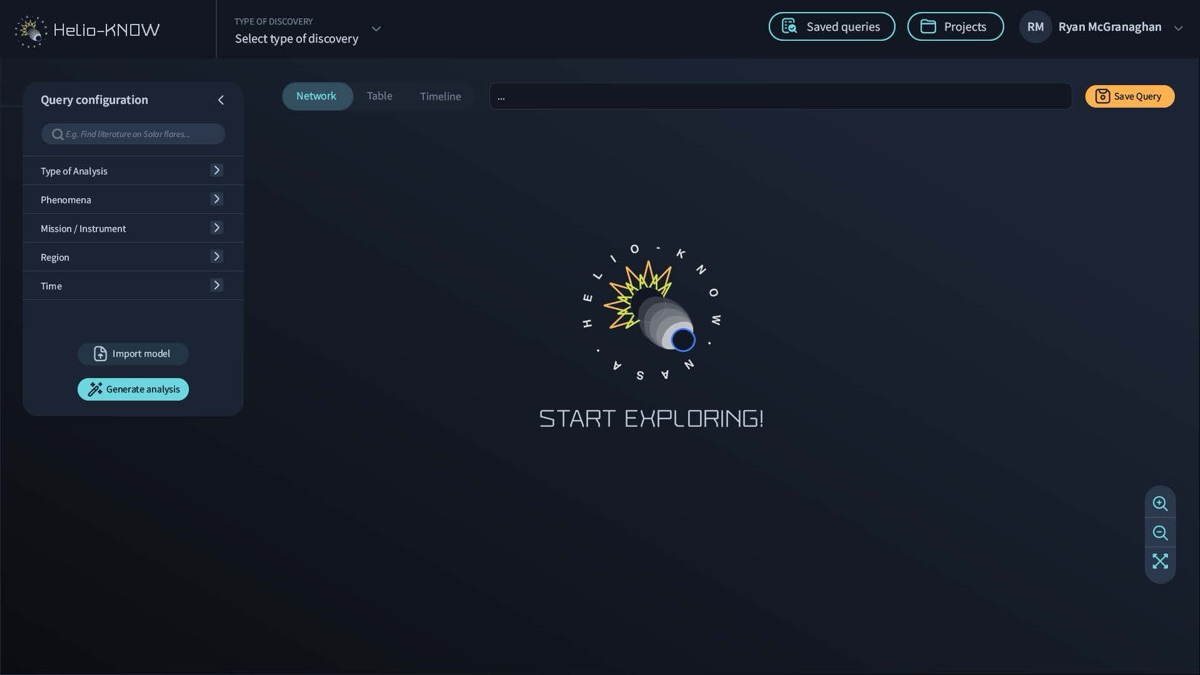
KnowHax: HelioKNOW
Helio-KNOW: Heliophysics Data Exploration Platform
Interface for exploring heliophysics data through networks, tables, and timelines
Jun 2024
Plain-language chatbot to discover underrepresented researchers in OpenAlex knowledge graph
Built by 1 person (Team 20) · September 2025 · AI Knowledge
This system lets users ask questions in plain language about researchers, topics, and institutions in the OpenAlex research database. It focuses on illuminating diversity by highlighting underrepresented contributors in science, starting with researchers at HBCUs including Georgia Tech, Morehouse College, Clark Atlanta University, and University of Buffalo. The system uses Retrieval Augmented Generation to answer questions with exact insights from the knowledge graph, reducing hallucinations from generative language models. It calculates centrality and community information to help discover underrepresented researchers whose work might otherwise be hard to find.
The team built a functional system with three main components: an ETL pipeline that extracts OpenAlex data and loads it into Neo4j, augmentation that adds centrality and community labels to the data, and a web UI retrieval app that answers user questions with graph insights. The generic ETL design uses only about 600 lines of code and defines labels and properties of interest simply, making it easily adaptable to other datasets like clinical trials. The approach combines the OpenAlex graph-based research database with modern language model chatbots.
The system makes research insights accessible to users without technical knowledge of Cypher query languages. Previously, fully utilizing OpenAlex required programming skills. Primary beneficiaries include Georgia Tech, Morehouse College, Clark Atlanta University, University of Buffalo, independent researchers, and companies. The prototype successfully answered target personas' questions that would normally require technical skills.
Users can ask questions in plain language instead of needing to know Cypher query languages or have programming skills. The system calculates centrality and community information that enables discovery of underrepresented researchers.
Yes. The generic ETL design is easily adaptable to other use cases and datasets, such as clinical trials. The system builds knowledge graphs from JSON inputs based on use case needs, with almost nothing hardcoded.
The fully functional code includes ETL from OpenAlex to Neo4j, data augmentation with centrality and community labels, and a web UI retrieval app that answers user questions with graph insights. Visual interactive graph and improved Q&A capabilities are planned.
KnowHax: HelioKNOW
Interface for exploring heliophysics data through networks, tables, and timelines
Jun 2024
Network Graphs · OpenAlex API · Python
CollabNext
Interactive map visualizing HBCU research collaborations and institutional connections through OpenAlex data
6 builders · Sep 2025
Knowledge Graphs · Retrieval Augmented Generation · Natural Language Processing
CollabNext
Reduces hallucinations in generative LLMs by summarizing insights from Knowledge Graphs.
1 builder · Jun 2024
From the GenHax blog and press room.
In one week, five million students got a free AI agent, top universities walked away from AI detectors, and a new study found that how students use AI matters more than whether they use it. Here is what proof of learning looks like next.
On January 16, 2026, GenHax's own team facilitated an NSF session connecting seven federally-funded Proto-OKN research teams to industry. Nine months later, one of those teams shipped a research paper, two colleges started piloting the same challenge, and the week closed with a global argument over how young is too young to teach a kid to use any of it.
Bring a real problem. GenHax brings the builders, mentors and AI tools, and you get working solutions like this one.
Run a challenge with GenHaxSign in to complete your public profile, show your skills next to this solution, or choose to hide your name.
Sign in to your profile