
Every Student Needs a Circle: Mentors, Social Capital, and Faculty as Connectors
By Mihaja Rakotoson (Mia)
Editor's note before publishing: Three items in this draft need verification. (1) The recent-graduate unemployment figures come from a third-party copy of New York Fed data because the Fed's page would not load, so check them against the Fed's own file. (2) A few NACE and Burning Glass numbers come from news summaries of the reports rather than the reports themselves; each is labelled that way in the sources list. (3) The Purdue pilot numbers come from GenHax records, and Randell and Keith should approve how their programs are described, with Randell free to add newer data. Delete this note once those checks are done.
The Missing Ingredient in Career Readiness
Ask a hiring manager how they found their best recent hire and you will hear a surprising number of stories that begin with a person. A professor made an introduction. A former supervisor mentioned a name. A friend of a friend said, you should talk to her. Skills matter, and the credentials that certify them matter, but both travel through networks. A student with strong skills and no one to vouch for them is working with half of what the job market actually rewards.
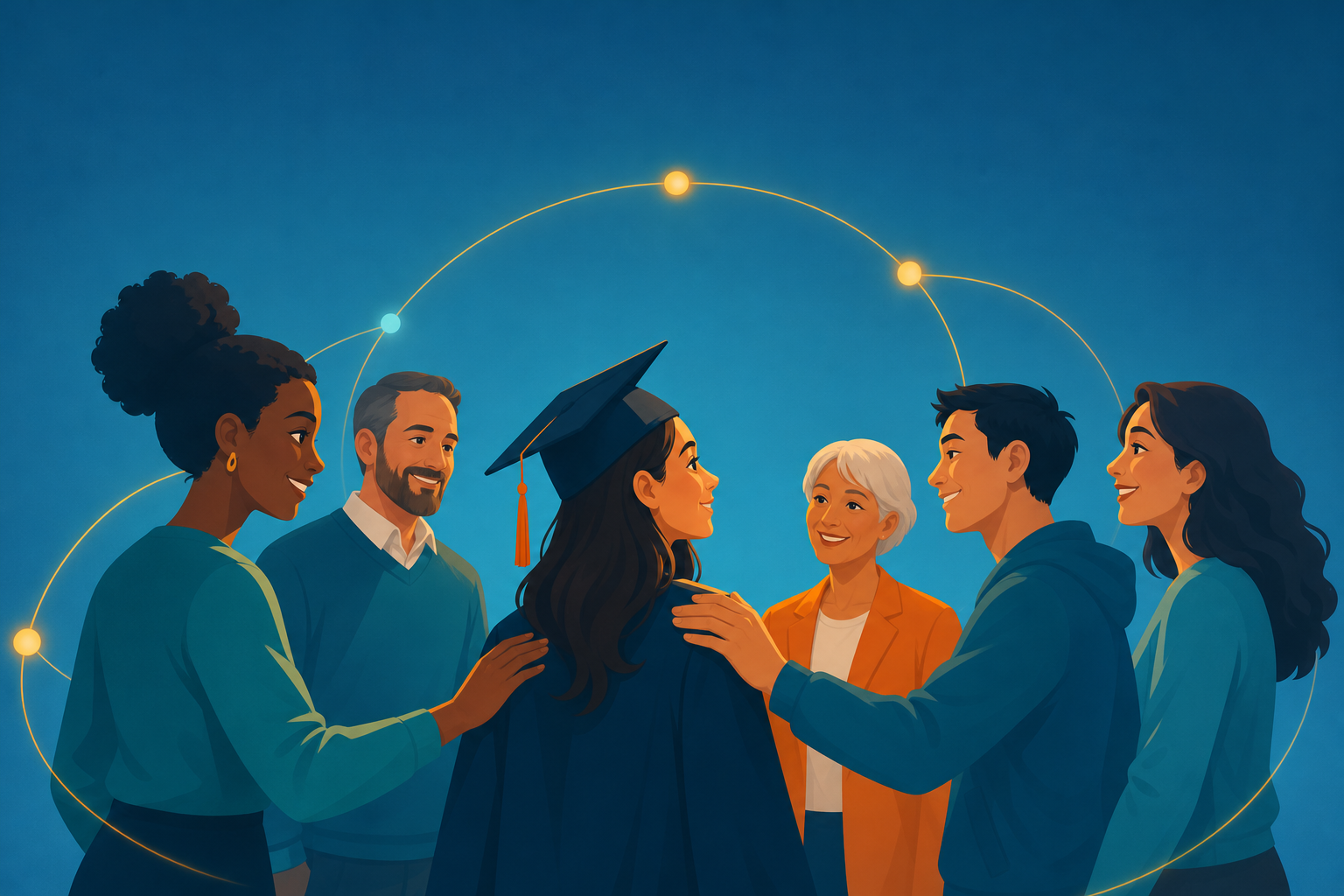
This is the argument behind the idea that every student needs a circle: a small group of people who know them, believe in them, and can open doors on their behalf. Colleges have spent decades building curricula and career centers. Far less attention has gone to the question of who, exactly, is in each student's corner. The research suggests that answer varies enormously by background, and that the variation shapes outcomes more than most of us would like to admit.
What Chetty's Research Tells Us About Friendship and Mobility
The most influential recent evidence on social capital comes from economist Raj Chetty and his collaborators at Opportunity Insights. Using anonymized Facebook data covering tens of millions of users, the team measured what they call economic connectedness: the share of a person's friends who come from higher-income backgrounds. Their central finding was striking. Of the factors they tested, cross-class friendship was among the strongest predictors of upward mobility. Children from low-income families who grew up in communities where they befriended more higher-income peers were substantially more likely to climb the income ladder as adults.
It is worth being precise about what this does and does not show. The finding is a strong association with careful controls, not a proof that any single friendship causes any single outcome. But it points to something intuitive that educators already sense. Opportunity is not only a matter of what you know. It is also a matter of who you know, who knows you, and what information and encouragement flow through those ties. Friendships across income lines carry tacit knowledge about how institutions work, what jobs exist, and what is realistic to aim for.
A second lesson in the Chetty work matters for higher education. Segregation by income shapes who meets whom, and campuses are one of the few places where young people from different backgrounds share space for years. But sharing space is not the same as forming bonds. Within a single college, students often sort into groups that mirror their backgrounds. Deliberate design, not proximity alone, is what turns a diverse campus into a connected one.
The Mentor Gap Is Larger Than We Think
If friendships matter, mentors matter more, because a mentor is a relationship built specifically to transfer guidance and access. Here the numbers are sobering. In the Gallup-Purdue Index, a large survey of college graduates, only about 22 percent said they had a mentor who encouraged them to pursue their goals and dreams. Put differently, roughly four in five graduates finished college without that experience.
The same research linked the presence of a supportive mentor, along with experiences like internships and long-term projects, to stronger long-term well-being and engagement at work. Again, this is correlation rather than a controlled experiment, and students who find mentors may differ from those who do not in ways the survey cannot capture. Still, the direction of the evidence is consistent across many studies of mentoring, and the scale of the gap is the real story. A benefit that is both valuable and rare is a design problem.
Consider the context of the current job market. Recent graduates have faced elevated unemployment relative to the overall workforce, a pattern documented in New York Fed data on recent-graduate labor market outcomes. In a market where entry-level openings are tight, an introduction or a strong reference can be the difference between a résumé that gets read and one that does not. The students least likely to have those relationships are the ones with the least margin for error.
Who Gets the Internship and the Research Role
The mentor gap is not distributed evenly. Studies of first-generation college students consistently find that they are less likely to hold internships and to participate in undergraduate research than their continuing-generation peers. The reasons are practical as much as cultural. Unpaid or low-paid internships assume a family that can absorb the cost. Research positions are often filled through informal conversations, and a student who does not know that such positions exist, or does not feel entitled to ask, never enters the conversation. Many first-generation students also work substantial hours to pay for school, leaving little room for the unpaid, relationship-building activities that more advantaged peers treat as routine.
A recent preprint adds a more unsettling data point about how informal systems can skew. The study, which has not yet been peer reviewed and should be read with that caution, examines how nine judges evaluating the same material ended up deciding with only two effective votes. The authors' point is that when evaluation runs through a small number of informal channels, the apparent breadth of a decision can mask a very narrow base of actual judgment. Whatever its final form after peer review, the finding fits a pattern educators will recognize: opportunities that appear open often flow through a handful of gatekeepers, and students outside the gatekeepers' view are simply not considered.
Faculty as Connectors, Not Just Instructors
If the circle is the missing piece, who is best positioned to build it? For most students, the answer is faculty. Professors are the adults students see most often, and a single professor can act as a bridge to a research lab, an industry contact, a conference, or a graduate program. The shift required is a change in how we describe the role. A faculty member who thinks of themselves only as a transmitter of content will teach well and connect no one. A faculty member who thinks of themselves as a connector asks a second question after every class: who does this student need to meet?
Connecting is a skill with concrete, low-cost practices. Make introductions explicit and specific rather than vague. Invite students to office hours with a reason, such as a short list of questions to bring, so that the visit does not feel like an imposition. Share your own professional network when a student's interests match a contact's work. Forward opportunities to students who would not otherwise see them, and pay particular attention to the quiet students who would never knock on your door. Small acts of attention are how circles begin.
None of this asks faculty to take on an unlimited mentoring load. The aim is to widen the number of students who receive a few well-aimed connections, not to deepen the relationship with the few who already seek it out. Institutions can support this by recognizing connecting work in workload and promotion decisions, since a practice that goes unrewarded tends to shrink under pressure.
Two Case Studies: Medgar Evers and Purdue
Two programs illustrate how institutions can build circles on purpose. Medgar Evers College in Brooklyn, a CUNY institution serving a large population of students from underrepresented and lower-income backgrounds, has leaned into structured mentoring and career preparation as part of its approach to student success. Its work shows that a mission-driven institution without a deep alumni donor base can still engineer connection by organizing faculty, staff, and community partners around students' progress rather than leaving relationships to chance.
At Purdue, a pilot connected to GenHax has explored how project-based, employer-linked work can generate the relationships and visible evidence of skill that students need. The figures cited for this pilot come from GenHax program records rather than an independent evaluation, and the way both programs are described here is pending review by Randell and Keith, who run them and may have newer data to add. Treat both descriptions as provisional until they sign off. The broader takeaway does not depend on any single number: when programs deliberately place students in contact with practitioners, relationships follow.
Beyond Alumni: Widening the Pool of Volunteers and Opening the Materials
A common reflex is to solve the mentor shortage by recruiting alumni. Alumni are valuable, but relying on them alone reproduces the inequality we are trying to fix, because institutions with wealthy, well-placed alumni get more help and institutions without them get less. The better move is to widen the circle of volunteers. Local employers, retirees, professionals from nearby organizations, graduate students, and advanced undergraduates can all serve as mentors, interviewers, and project advisors. Many people are willing to give an hour a month if asked clearly and given a defined role. The institution's job is to make that giving easy and to make sure the benefit reaches students who would otherwise be skipped.
Open course materials belong in this conversation too. When syllabi, assignments, and learning resources are openly available, outside practitioners can see what students are working on, and a volunteer can offer feedback on a real project without needing a login or a lengthy orientation. There is also evidence that open educational resources help students directly by lowering cost barriers, and lower costs free time and money that students can redirect toward the unpaid, relationship-building experiences discussed above. Openness makes it easier for the circle to form around the work.
Building the Circle on Purpose
The lesson of the research is not that students lack ambition or that skills do not count. It is that access to people is unevenly distributed, and that colleges are among the few institutions positioned to even it out. A circle does not require a grand program. It requires a deliberate decision that every student, not only the confident or well-connected ones, will leave with at least a few people who know their work and will speak for it.
Start small. Audit who in your courses has had a real conversation with you this term, and reach out to someone who has not. Look at which students hold your department's internships and research slots, and ask who is missing. Recruit three volunteers from outside your alumni base. Make one introduction this week. The students who most need a circle are often the ones least likely to ask for it, which means the invitation has to come from us.