AI KnowledgeIntermediateUpcoming
Fix the Broken Map: Rebuilding America's Homeless Resources Data
“Outdated shelter data leaves thousands calling disconnected numbers while empty beds go unfilled. Can you fix it?”
The Challenge
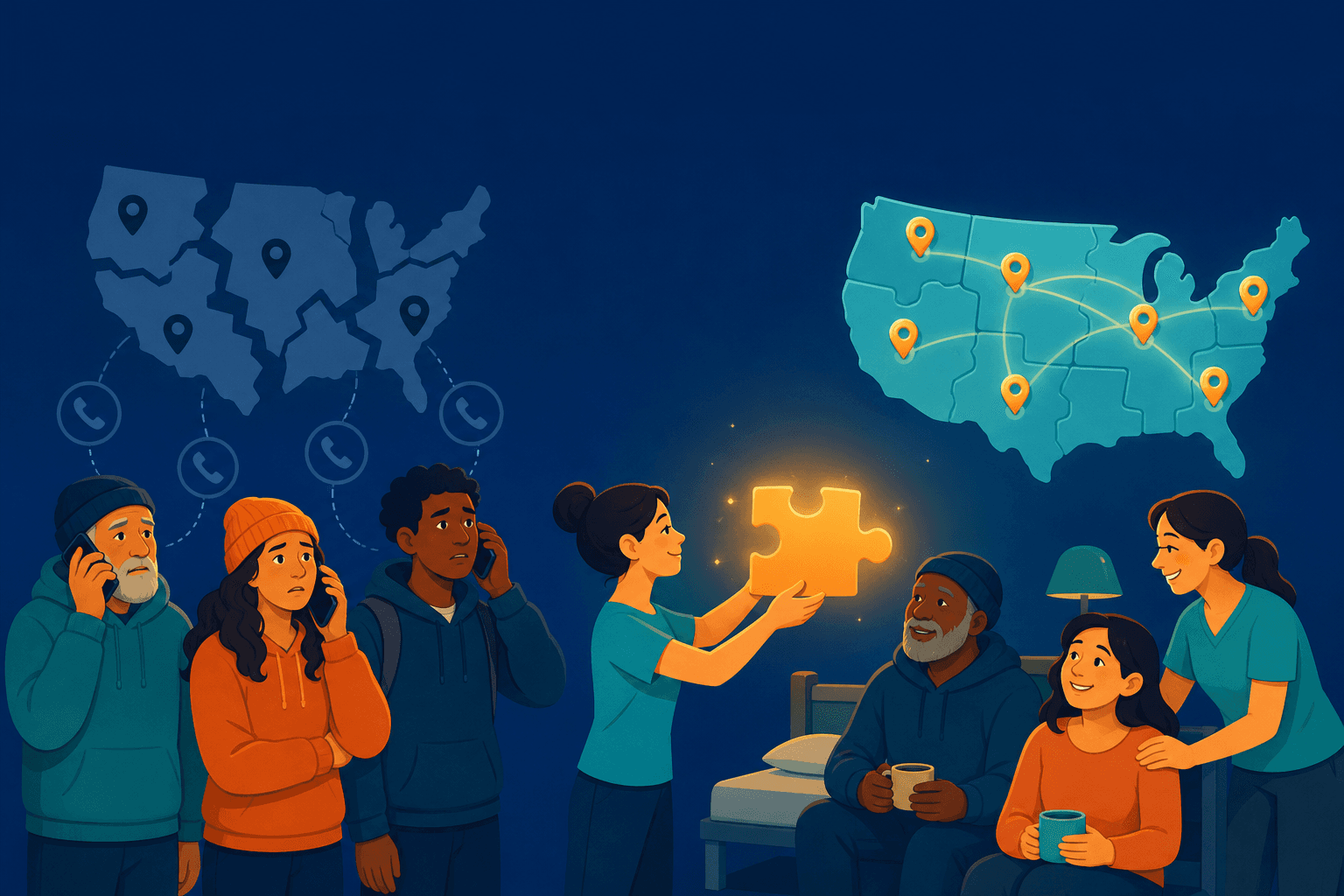
Every winter, people experiencing homelessness die calling shelters with disconnected phone numbers. During last year's cold snaps, outreach workers across major cities found that 40-60% of listed shelter contacts were wrong: disconnected numbers, outdated addresses, closed facilities. Meanwhile, beds sit empty because accurate information doesn't exist where it's needed most. The data exists, scattered across government databases, nonprofit directories, 211 systems, and street outreach records. But these sources contradict each other and decay within months. New AI techniques for data reconciliation, automated validation, and continuous maintenance make it possible to solve this at scale. The right approach could save lives by ensuring accurate information reaches people in crisis. We're looking for solutions that can integrate multiple data sources, identify and resolve conflicts, validate information through multiple signals, and maintain accuracy over time. Your solution should demonstrate how real-time, reliable homeless resources data can connect people to help when seconds matter. Show us how technology can turn fragmented, outdated information into a dependable lifeline.
Timeline
Challenge Kickoff & Data Source Overview
KickoffThu, Nov 19, 2026
Launch event introducing the challenge, reviewing available data sources, and forming teams to tackle homeless resources data reconciliation.
Data Integration Milestone Check-in
MilestoneFri, Nov 20, 2026
Teams demonstrate their data reconciliation approaches and receive technical feedback on validation strategies and conflict resolution methods.
Final Submission Deadline
DeadlineFri, Nov 20, 2026
All solutions must be submitted demonstrating real-time data integration, validation, and accuracy maintenance for homeless resources.
About This Challenge
## Overview Across America, a deadly information gap exists between people experiencing homelessness and the resources meant to help them. Shelter hotlines list disconnected phone numbers. Online directories point to closed facilities. Capacity information is hours or days out of date. The result: people in crisis spend precious hours calling numbers that don't work, walking to addresses that don't exist, and missing opportunities for shelter, meals, and services. This isn't a problem of missing data. Multiple systems collect homeless resources information: HUD Continuum of Care databases, 211 information systems, municipal homeless services portals, nonprofit directories, and street outreach records. The problem is that these sources contradict each other, contain errors, and become outdated within months of publication. When datasets disagree, frontline workers and people seeking help have no way to know which information is correct. During extreme weather events, this information crisis becomes life-threatening. Winter storms and summer heat waves kill homeless individuals who couldn't find shelter because the information they had was wrong. This challenge asks: can we build systems that ensure accurate, real-time homeless resources data reaches people when they need it most? ## Background The fragmentation of homeless resources data creates cascading failures throughout the system. A shelter changes its phone number, but only updates it in two of the five databases where it's listed. A facility expands capacity, but the information takes three weeks to propagate. An organization closes its doors, yet remains listed in directories for months. Current approaches to maintaining this data rely heavily on manual updates, periodic surveys, and phone verification campaigns. These methods are labor-intensive, expensive, and immediately out of date. By the time someone calls to verify a shelter's information, circumstances may have already changed. The result is a constant state of data decay where accuracy rates of 50-60% are considered acceptable. The consequences hit hardest during crises. When a polar vortex hits, emergency shelters open overflow capacity, but this information may not reach coordination systems for hours or days. When heat waves strike, cooling centers activate, but outdated contact information means vulnerable populations can't find them. Outreach workers waste time traveling to facilities that have moved or closed, time they could spend connecting people to actual resources. Meanwhile, advances in data integration, conflict resolution algorithms, automated validation techniques, and AI-powered information maintenance offer new possibilities. Systems that can cross-reference multiple data sources, identify discrepancies, validate information through various signals, and flag probable errors could dramatically improve data accuracy and freshness. ## What We're Looking For We're seeking solutions that address the core challenge of maintaining accurate, up-to-date homeless resources data across fragmented systems. Your approach should demonstrate: Data Integration and Conflict Resolution: Methods to combine multiple data sources (government databases, nonprofit directories, 211 systems, outreach records) and resolve conflicts when sources disagree. How do you determine which source is most reliable? How do you handle partial information or missing fields? Automated Validation: Techniques to verify information accuracy without relying solely on manual phone calls. This might include web scraping for facility websites, social media monitoring, pattern analysis of call outcomes, or other signals that indicate whether listed information is current and correct. Continuous Maintenance: Systems that keep data fresh over time, flagging information that's likely outdated based on age, change patterns, or other indicators. How do you identify when information needs reverification? How do you prioritize validation efforts? Real-World Application: Your solution should show how improved data reaches the people who need it: individuals seeking shelter, outreach workers, emergency coordinators, or service providers. Consider the full chain from data improvement to actual impact. Your submission should include a working prototype or detailed technical approach, demonstration using real or realistic test data (with appropriate privacy protections), documentation of your methodology, and clear metrics showing improvement over current approaches. ## Expected Outcomes Successful solutions will demonstrate measurable improvements in data accuracy, freshness, and usability. We expect to see approaches that can achieve 90%+ accuracy rates for critical contact information (phone numbers, addresses, hours) and identify outdated information within days rather than months. The best solutions will be practical and scalable. They should work with existing data sources and systems rather than requiring wholesale replacement. They should reduce the manual effort required to maintain accurate data while improving outcomes. They should be deployable in cities and regions of varying sizes and technical sophistication. Ultimately, we're looking for solutions that save lives by ensuring that when someone experiencing homelessness seeks help, the information they receive is accurate the first time. Your work could become the foundation for better homeless services coordination across the country, helping cities turn fragmented data into reliable, life-saving information.
Research Team
## Research Team This challenge would support interdisciplinary research teams working at the intersection of public health informatics, data science, and social services research. The ideal research profile combines technical expertise in distributed data systems and machine learning with deep domain knowledge of homeless services delivery and crisis response systems. Teams might be based in schools of public health, social work, or information science, with collaborative partnerships across departments. Key expertise areas include: - Data integration and quality: Researchers experienced with conflicting data sources, entity resolution, and automated validation methods - Human-centered computing: Teams focused on information systems design for vulnerable populations and crisis scenarios - Public health informatics: Researchers studying health information exchange, especially in fragmented care environments - Social services operations research: Investigators analyzing homeless services systems, resource allocation, and coordination mechanisms Challenge participants' work would provide these teams with practical validation of technical approaches in real-world settings. Submitted solutions would demonstrate which data quality methods actually improve accuracy in production environments, how automated systems perform compared to manual verification, and which validation signals prove most reliable for different resource types. Research teams could incorporate winning approaches into broader studies of information infrastructure for social services, use the challenge results to inform best practices for homeless services data management, and leverage participant innovations to develop scalable implementations across multiple jurisdictions.
Resources
# Data Sources for Homeless Resources Data Challenge ## Federal Government Datasets - HUD Continuum of Care (CoC) Program Data - Geographic areas, funding, and homeless assistance providers - https://www.hudexchange.info/programs/coc/coc-homeless-assistance-programs/ - https://www.hud.gov/program_offices/comm_planning/coc/data - HUD Housing Inventory Count (HIC) - Bed inventory for emergency shelter, transitional housing, safe havens, and permanent supportive housing - https://www.hudexchange.info/resource/3031/pit-and-hic-data-since-2007/ - HUD Point-in-Time (PIT) Count Data - Annual count of sheltered and unsheltered homeless persons - https://www.hudexchange.info/programs/hdx/pit-hic/ - HUD Homelessness Data Exchange (HDX) - Annual performance reports on CoC programs - https://www.hudexchange.info/programs/hdx/ - SAMHSA Behavioral Health Treatment Services Locator - Mental health and substance abuse treatment facilities (many serve homeless populations) - https://findtreatment.samhsa.gov/ - https://www.samhsa.gov/data/ - Veterans Affairs Homeless Programs Directory - VA-funded homeless services and facilities - https://www.va.gov/homeless/ - https://www.va.gov/directory/guide/home.asp ## State and Local Government Data - 211 Data Exchange - United Way 211 information and referral services data - https://www.211.org/ - Contact local 211 operators for API access - Local government open data portals for major cities: - NYC Open Data - https://opendata.cityofnewyork.us/ (search "homeless services") - Los Angeles Open Data - https://data.lacity.org/ (DHS facilities and services) - San Francisco Open Data - https://datasf.org/ (HSA locations and services) - Chicago Data Portal - https://data.cityofchicago.org/ (homeless shelters and services) - Seattle Open Data - https://data.seattle.gov/ (human services) - Washington DC Open Data - https://opendata.dc.gov/ (homeless services) - State homeless management information systems (HMIS) - Contact state CoC coordinators for data sharing agreements ## Nonprofit and NGO Databases - Homeless Shelter Directory - Crowdsourced national directory - https://www.homelessshelterdirectory.org/ - May offer bulk data access upon request - National Alliance to End Homelessness Data - Research and policy data - https://endhomelessness.org/homelessness-in-america/homelessness-statistics/state-of-homelessness/ - Aunt Bertha (now Findhelp.org) - Social care network with extensive service provider data - https://www.findhelp.org/ - https://developers.findhelp.com/ (API available) - iCarol Resource Database - Used by many 211 and information/referral services - Contact regional iCarol implementations for data partnerships - Open Referral Initiative - Open standard and implementations for health and human services data - https://openreferral.org/ - https://github.com/openreferral ## Mapping and Location Data - OpenStreetMap - Crowdsourced mapping data with amenity tags for shelters and social services - https://www.openstreetmap.org/ - Overpass API: https://overpass-api.de/ - Query tags: `amenity=shelter`, `amenity=social_facility` - Google Places API - Business listings including nonprofits and shelters - https://developers.google.com/maps/documentation/places/web-service - Bing Maps API - Alternative mapping and location data - https://www.microsoft.com/en-us/maps/choose-your-bing-maps-api - Foursquare Places API - Location data and venue information - https://location.foursquare.com/products/places-api/ ## Phone and Contact Validation - Twilio Lookup API - Phone number validation and carrier information - https://www.twilio.com/docs/lookup/api - Numverify API - Phone number validation (freemium model) - https://numverify.com/ - Abstract Phone Validation API - Real-time phone number validation - https://www.abstractapi.com/phone-validation-api ## Social Services and Community Data - SAMHSA National Directory of Drug and Alcohol Abuse Treatment - Treatment facility locator - https://findtreatment.gov/ - https://www.samhsa.gov/data/data-we-collect/national-directory-drug-alcohol-abuse-treatment-facilities - HRSA Health Center Program Data - Federally Qualified Health Centers serving homeless populations - https://data.hrsa.gov/tools/data-reporting/program-data - https://findahealthcenter.hrsa.gov/ - USDA Food and Nutrition Service SNAP Retailer Locator - Food assistance locations - https://www.fns.usda.gov/snap/retailer-locator - Feeding America Food Bank Network - Food bank locations - https://www.feedingamerica.org/find-your-local-foodbank ## Weather and Climate Data (for crisis correlation) - NOAA National Weather Service API - Weather alerts and forecasts - https://www.weather.gov/documentation/services-web-api - NOAA National Centers for Environmental Information - Historical weather data - https://www.ncei.noaa.gov/ - OpenWeatherMap API - Current and historical weather data - https://openweathermap.org/api ## Research Repositories and Academic Sources - ICPSR Social Science Data - Research datasets on homelessness - https://www.icpsr.umich.edu
Skills
You'll Learn
Neo4jSystems ThinkingRAG SystemsPythonSQLData Quality ManagementData Pipeline DevelopmentInnovation MindsetKnowledge Graph EngineeringProblem SolvingStakeholder CommunicationReal-time AnalyticsEntity ResolutionGraph Database DesignPrompt EngineeringTask CompletionStrategic ThinkingData Governance
Helpful to Have
API Integration

Hosted by
Mihaja Rakotoson (Mia)
0 teams / 50 max
Starts Nov 19, 2026, 10:00 AM (EDT)
Ends Nov 21, 2026, 11:59 PM (EDT)