NY STEPIntermediateIn Progress
NY STEP - Autonomous Campus Delivery Robot
“Learn more in a few seconds: https://www.renderforest.com/watch-113352421?quality=720”
The Challenge
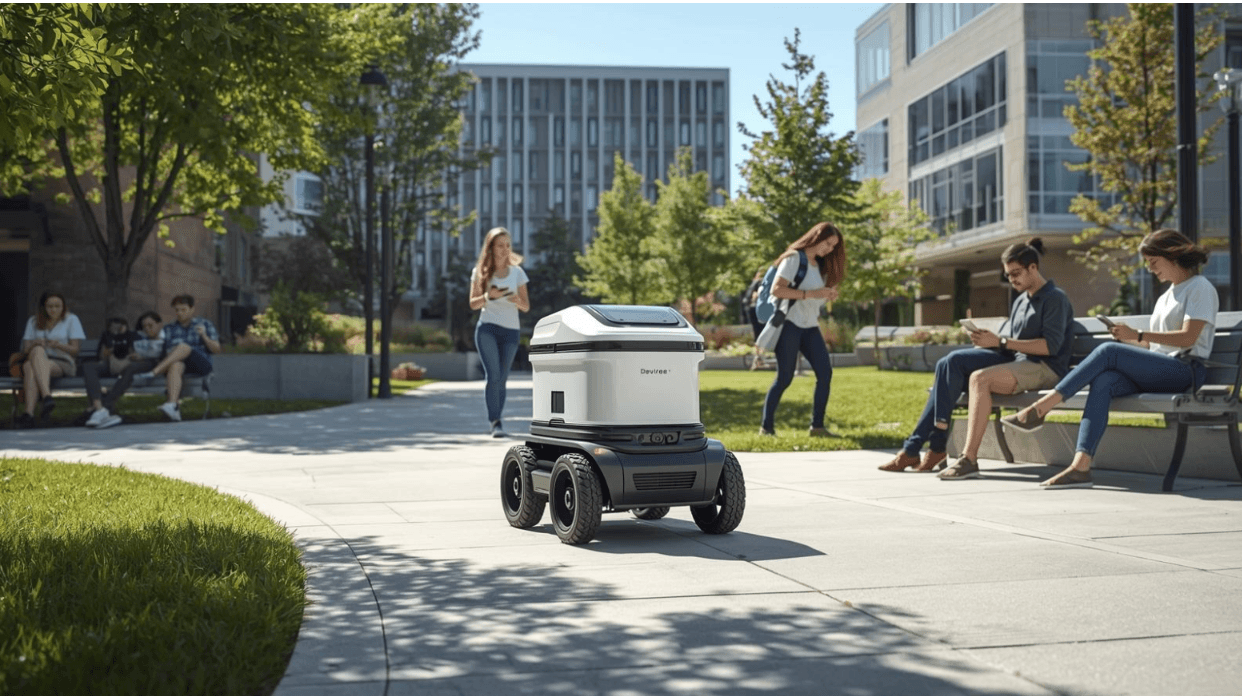
Who hasn't been dreaming of food delivered to you on campus when you need it? Design and build a working delivery robot that brings meals directly to students anywhere on campus. Mechanical, Civil, and Industrial Engineering students collaborate to solve the last-mile delivery problem through hands-on prototyping. Mechanical engineers design the chassis and mobility systems, Civil/Industrial engineers map optimal routes and analyze campus infrastructure, while embedded software teams program navigation and obstacle avoidance. Create a portfolio-ready prototype addressing real campus needs, gain interdisciplinary collaboration experience, and demonstrate your working robot to the campus community.
Timeline
Challenge Kickoff & Team Formation
KickoffThu, Oct 29, 2026
Introduction to the autonomous delivery robot challenge, team formation across Mechanical, Civil, and Industrial Engineering disciplines, and initial project scope discussion.
Campus Infrastructure Analysis Milestone
MilestoneMon, Nov 2, 2026
Teams submit completed campus route mapping, terrain analysis, and preliminary delivery zone identification reports.
Mentor Session: Navigation & Obstacle Avoidance
Mentor SessionThu, Nov 12, 2026
Expert mentors provide guidance on sensor integration, pathfinding algorithms, and real-time obstacle detection strategies.
Mid-Project Prototype Demonstration
Pitch EventThu, Nov 26, 2026
Teams showcase functional prototypes with basic mobility and navigation capabilities to receive feedback from judges and peers.
Final Robot Demonstration & Submission
DeadlineThu, Dec 10, 2026
Teams present their completed autonomous delivery robots with live campus demonstrations and submit final documentation and portfolios.
About This Challenge
Challenge Overview This challenge invites Civil, Industrial, and Mechanical Engineering students to design and prototype an autonomous delivery robot that brings meals directly to students anywhere on campus. Students will combine hardware design, embedded systems programming, and real-world problem-solving to create a working prototype inspired by delivery robots already deployed at University of Arizona, Miami streets, and restaurants nationwide. This is hands-on engineering meets software development, bridging mechanical design with the digital systems that bring robots to life. See the challenge overview here: https://www.renderforest.com/watch-113352421?quality=720 Problem Statement Students are busy. Between classes, work, and study sessions, trekking to the cafeteria isn't always feasible. While mobile ordering exists on campus, the last-mile delivery problem remains unsolved. Current gaps: No autonomous solution for on-campus meal delivery Students lose valuable time walking to/from dining halls Existing delivery relies on human couriers (costly, limited availability) Campus infrastructure (pathways, elevations, obstacles) presents unique engineering challenges This challenge tackles that gap by empowering engineering students to build the delivery system of the future. Cohort Roles & Responsibilities 1. Mechanical Engineering Cohort Role: Physical design & robotics specialists Responsibilities: Design the robot chassis, wheels/mobility system, and payload compartment Ensure stability across varied terrain (sidewalks, ramps, grass, thresholds) Create food-safe, temperature-controlled delivery containers Prototype structural components using CAD and fabrication tools Collaborate with embedded systems team on sensor/motor integration Skills developed: CAD modeling, materials selection, prototyping, mechanical systems integration 2. Civil/Industrial Engineering Cohort Role: Systems optimization & campus infrastructure specialists Responsibilities: Map campus pathways, identify optimal delivery routes Analyze traffic flow, accessibility, and safety requirements Design routing algorithms considering obstacles, elevation changes, and pedestrian zones Propose infrastructure modifications if needed (charging stations, designated robot lanes) Study operational efficiency, cost modeling, and scalability Skills developed: spatial analysis, optimization, logistics planning, systems thinking 3. Embedded Software/Controls Team (Cross-trained engineers) Role: Software & automation specialists Responsibilities: Program navigation and obstacle avoidance systems Integrate sensors (LIDAR, cameras, GPS, ultrasonic) with control logic Develop user interface for order placement and robot tracking Learn embedded programming (e.g., Arduino, Raspberry Pi, ROS) Implement safety protocols and fail-safes Skills developed: embedded systems, programming (Python/C++), sensor integration, app development basics Learning Outcomes Students will gain: Interdisciplinary collaboration: Mechanical, civil, and software engineering working together Embedded systems experience: Programming hardware, not just simulations Real-world prototyping: From concept sketches to functioning hardware Problem-solving under constraints: Budget, time, materials, campus regulations Portfolio-ready project: Tangible, demonstrable engineering work Deliverables Team Deliverables: 1. Working robot prototype (even if limited functionality) 2. Technical documentation (CAD files, code, system diagrams) 3. Campus route maps and feasibility analysis 4. Final presentation with live demonstration Individual Deliverables: Personal reflection on role and learnings Portfolio-ready case study [Certificates/badges upon completion] Impact & Value For students: Build a real-world engineering system, gain embedded and cross-disciplinary skills, and create a strong portfolio project. For educators: Deliver hands-on, multidisciplinary STEM learning aligned with service-learning and C-STEP outcomes. For the campus community: Pilot a student-designed solution to a real campus need with potential for future automation. For society: Prepare future engineers to responsibly design and deploy autonomous and logistics technologies.

Hosted by
Mahesh
0 teams / 50 max
Starts Oct 22, 2026, 10:00 AM (EDT)
Ends Dec 10, 2026, 4:00 PM (EDT)