NY STEPBeginnerIn Progress
NY STEP - DREAM for the homeless - Multidisciplinary App Building
“Empower first responders to help the homeless better, faster, and securely”
The Challenge
First responders like firemen, nonprofit volunteers or ambulance drivers / emergency technicians have NO way to see what shelter has available beds. This leads to long waits and unstable situations with homeless people. This also sometimes makes it impossible to help vulnerable people and endangers their lives. Build a real-world application that helps first responders guide homeless individuals to available shelter beds while navigating high-risk situations safely and humanely. Students from Computer Science, Nursing, Psychology, and Cybersecurity collaborate to create a secure, trauma-informed solution that addresses fragmented shelter information, respects medical ethics and privacy laws, and provides de-escalation guidance. Gain hands-on experience in cross-functional teamwork, ethical technology design, and creating solutions that genuinely impact vulnerable communities. https://gamma.app/docs/Homeless-Bed-Tracker-Challenge-j0cfpwunuy1fvho
Timeline
Challenge Kickoff & Team Formation
KickoffThu, Oct 29, 2026
Multidisciplinary teams form and receive challenge briefing on building a trauma-informed shelter bed tracking app for first responders. https://gamma.app/docs/Homeless-Bed-Tracker-Challenge-j0cfpwunuy1fvho
Ethics & Privacy Framework Milestone
MilestoneMon, Nov 2, 2026
Teams submit their medical ethics, HIPAA compliance, and data privacy framework documentation for review.
Mentor Office Hours: De-escalation & UI Design
Mentor SessionThu, Nov 12, 2026
Psychology and nursing mentors provide guidance on trauma-informed design and crisis de-escalation features.
Mid-Challenge Pitch & Prototype Demo
Pitch EventThu, Nov 19, 2026
Teams present working prototypes and demonstrate real-time shelter bed tracking functionality to first responders and judges.
Final Submission Deadline
DeadlineFri, Dec 4, 2026
All teams must submit their complete secure applications with documentation, demo videos, and deployment instructions.
About This Challenge
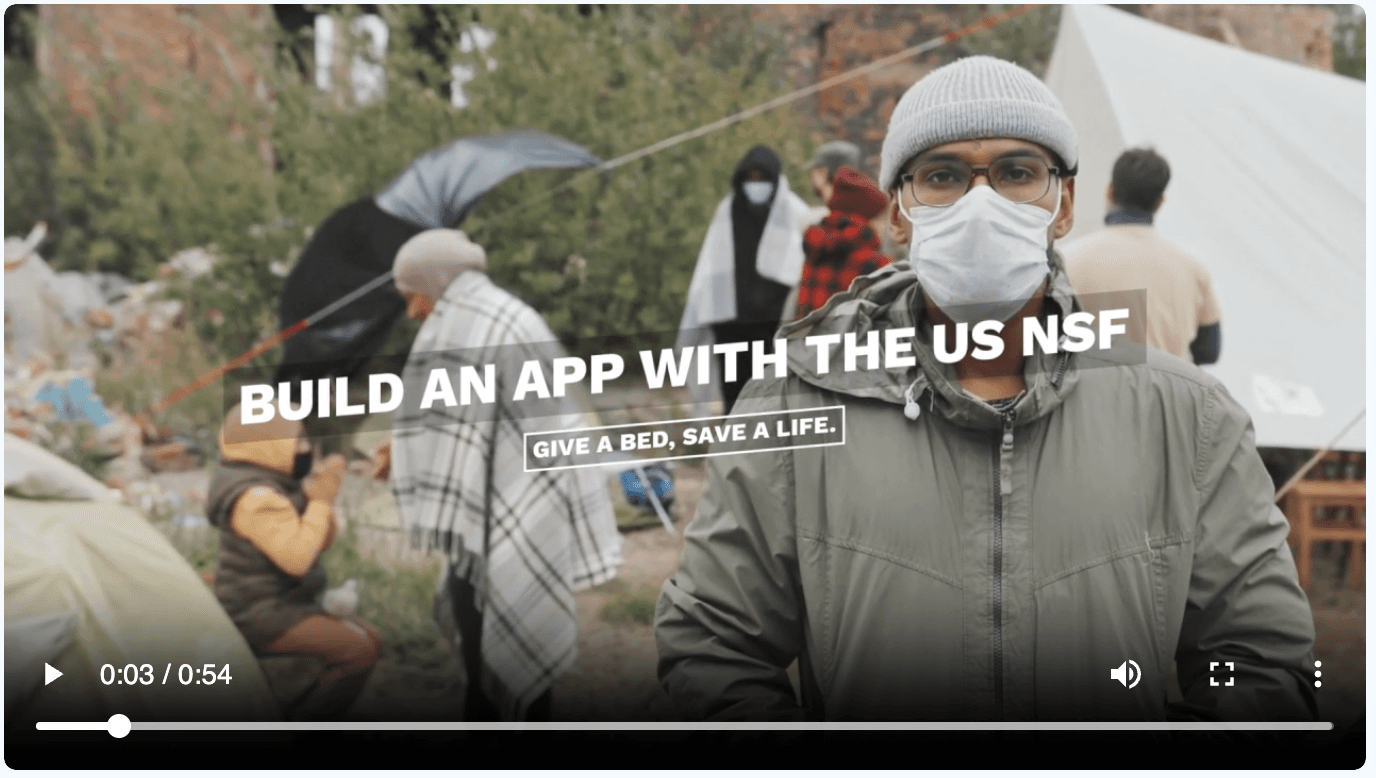
Overview: In this challenge, students from Computer Science, Nursing, Psychology, and Cybersecurity team up to design and build a real-world application that supports first responders interacting with all kinds of homeless individuals and families, including those experiencing violent or high-risk situations. The challenge goes beyond building software. It enables you to learn how to collaborate across disciplines, balance ethical care with real-world constraints, and design technology that is secure, trauma-informed, and practical under pressure. You gain hands-on experience in effective communication, data security, clinical awareness, and technical rigor. Just like you would in a professional environment! "Working with students from completely different majors made me realize how much better solutions are when you actually listen to each other." – Rachida A., Challenge participant 💬 By the end of the project, you don't just walk away with a working prototype, you leave with the incredible experience of building something that could genuinely make homeless people's lives better and more humane, while making it easier for first responders to serve the people they're called for. 🤝✨ See the Challenge in Action: https://www.renderforest.com/watch-113369403?quality=720 See the presentation https://gamma.app/docs/Homeless-Bed-Tracker-Challenge-j0cfpwunuy1fvho -- Problem Statement First responders often face high-risk situations involving homeless individuals with mental health challenges - and do not know easily where beds are available for them. There is a lack of integrated tools that: * Provide real-time guidance on available beds * Respect medical, psychological, legal, and ethical boundaries for safe, humane interactions * Secure sensitive data while remaining usable in the field This challenge addresses that gap through a multidisciplinary, experiential learning approach. Current Situation: How It Works Now The Problem in Action: When a first responder encounters a homeless individual in crisis: 1. Fragmented Information: Shelter bed availability is scattered across multiple phone numbers, websites, and city databases with no centralized system 2. Manual Calling: Responders must call shelters one-by-one to find available beds, wasting critical time 3. No Context: There's no record of previous interactions, mental health history, or what de-escalation approaches have worked before 4. Safety Risks: Responders approach potentially violent situations without adequate background information or guidance 5. Privacy Concerns: When information does exist, it's often stored insecurely or shared inappropriately Example Scenario: Officer Martinez responds to a call about an aggressive homeless individual near a subway station. She has no information about this person's mental health status, no guidance on de-escalation, and spends 45 minutes calling 8 different shelters to find an available bed. By the time she finds one, the individual has left the scene. Your Challenge: Build a system that solves these problems while respecting medical ethics, privacy laws, and the dignity of vulnerable populations. -- Cohort Roles & Responsibilities 1. Computer Science Cohort Role: Application & system builders Responsibilities: * Build the core application and backend services * Integrate Knowledge Graph (KG) queries into the app for bed availability and individual history * Translate real-world requirements into scalable software * Collaborate closely with domain experts to refine features How You'll Collaborate: * Week 1-2: You'll be assigned to cross-functional teams (see Team Structure below) * Weekly Cross-Cohort Sessions: Scheduled meetings where you'll work directly with Nursing, Psychology, and Cybersecurity students * Shared Documentation: All teams will use a shared requirements document where domain experts describe what they need and you translate it to technical specs * Mentor Touchpoints: Connect with technical mentors and domain experts like Analee Etheredge (NYC Health) during scheduled sessions Skills Developed: Full-stack development, APIs, data modeling, cross-functional teamwork, translating domain expertise into code Resources Available: * NSF Proto-OKN documentation * DREAM KG (Knowledge Graph for homeless services) * FRINK framework tutorials * Knowledge Graph integration guides * API documentation for shelter databases Mentoring: * College cohorts from QCC can mentor high-school cohorts from MEC * Technical mentors available during scheduled office hours -- 2. Nursing Cohort Role: Healthcare & domain experts Special angle for Psychology and Nursing students: https://www.renderforest.com/watch-113352178?quality=720 Responsibilities: * Provide medical and care-related insights * Define what is appropriate, ethical, and legal regarding health data (HIPAA compliance, consent, confidentiality) * Communicate healthcare needs clearly to technical teams * Practice professional project communication and leadership * Determine what medical information can/should be displayed to first responders How You'll Collaborate: * Week 1-2: Join your assigned cross-functional team * Requirements Workshops: Lead sessions explaining healthcare constraints to CS students * Review Sessions: Evaluate prototypes to ensure medical ethics are maintained * Documentation Role: Maintain the "Healthcare Boundaries" section of the shared project documentation Skills Developed: Interdisciplinary communication, applied healthcare ethics, systems thinking, translating clinical knowledge for non-medical audiences Example Contributions: * "First responders should see: recent hospital visits (yes/no), NOT diagnosis details" * "Consent must be obtained before storing any medical information" * "Here's what constitutes a medical emergency vs. a behavioral crisis" -- 3. Psychology Cohort Role: Mental health & behavioral experts Special angle for Psychology and Nursing students: https://www.renderforest.com/watch-113352178?quality=720 Responsibilities: * Design guidance for interacting with violent or distressed individuals * Define de-escalation and non-judgmental communication strategies * Help document what works for individuals over time (intervention history) * Embed trauma-informed and mental-health-aware practices into the app * Advise on ethical considerations around recording behavioral information How You'll Collaborate: * Week 1-2: Join your assigned cross-functional team * Scenario Design: Create realistic interaction scenarios for CS students to build features around * App Content: Write the actual de-escalation guidance that will appear in the app * Testing: Evaluate prototypes for trauma-informed design Skills Developed: Applied psychology, behavioral analysis, real-world impact design, translating psychological principles into actionable technology Example Contributions: * De-escalation flowcharts for the app * Crisis intervention protocols * Guidelines for recording behavioral notes ethically * Red flags that indicate when to call for additional mental health support -- 4. Cybersecurity Cohort Role: Security & privacy specialists Responsibilities: * Secure the application and underlying data * Address authentication, authorization, and access control (who can see what?) * Protect sensitive personal and health-related information * Balance usability with security and compliance (HIPAA, city data regulations) * Conduct security reviews of code and database design How You'll Collaborate: * Week 1-2: Join your assigned cross-functional team * Security Reviews: Evaluate CS team's code weekly for vulnerabilities * Policy Documentation: Work with Nursing cohort to translate HIPAA requirements into technical security controls * Testing: Conduct penetration testing on prototypes Skills Developed: Application security, privacy engineering, risk assessment, communicating security requirements to developers Example Contributions: * "All health data must be encrypted at rest and in transit" * "Implement role-based access control: first responders see X, shelter staff see Y" * "Here's how to securely log access to sensitive information" -- Team Structure You will work in cross-functional teams of 4-5 students: * 1-2 Computer Science students * 1 Nursing student * 1 Psychology student * 1 Cybersecurity student Team Meetings: * Scheduled during weekly project sessions * Teams set their own additional meeting times as needed * Mentor-facilitated sessions every 2 weeks Communication Expectations: * Respond to team members within 24 hours * Document all decisions in shared team space * Use professional communication standards (templates provided) Learning Outcomes Students gain: * Real-world, portfolio-ready project experience * Cross-functional teamwork and professional etiquette * Exposure to ethical, legal, and security constraints * Experience working on socially impactful technology * Understanding of how different disciplines approach the same problem * Professional communication skills across technical and non-technical domains Impact & Value * For students: Accelerated, experiential learning through real challenges that matter * For educators: Turnkey multidisciplinary project with real outcomes & NSF support * For researchers & partners: A platform to prototype ideas and gather insights * For society: Safer, more humane first-responder interactions with vulnerable populations * For homeless individuals: Better access to services, more respectful care, documented progress over time Getting Started Week 1: Orientation, team formation, introduction to the problem Week 2: Understanding shelters, services, and the Knowledge Graph Week 3: First cross-cohort collaboration workshop Week 4+: Build, iterate, test with mentor feedback Mentoring Available: * Weekly office hours with technical mentors * Domain experts like Analee Etheredge and her NYC Health team * Peer mentoring (QCC students mentor MEC students) * AI Chatbot for quick questions Final Deliverable: Pitching Ceremony with: * Research team * NY STEP parties * Nonprofit partners * City of New York representatives * Your working prototype, presentation, code repository, and demonstration video
Research Team
This challenge is powered by the DREAM Knowledge Graph (KG), a cutting-edge research initiative funded by the US National Science Foundation's Proto-OKN program. Led by Dr. Yuzhou Chen at UC Riverside and Dr. Huanmei Wu at Temple University, this groundbreaking project creates intelligent, interconnected data systems that can transform how we approach complex social challenges like homelessness. The DREAM KG doesn't just store information—it understands relationships between shelter capacity, individual needs, mental health resources, and safety protocols in ways that traditional databases cannot. When you build your application, you're working with real research infrastructure that maps the complex ecosystem of homelessness support services. What makes this special? Your multidisciplinary team gets to work with the same advanced knowledge representation techniques that researchers use to model complex social systems. Computer Science students learn how semantic web technologies can capture nuanced human needs. Nursing students see how clinical protocols can be digitally represented while preserving care standards. Psychology students explore how trauma-informed approaches translate into data structures. Cybersecurity students tackle the unique challenge of protecting vulnerable populations' data within research frameworks. This isn't just an academic exercise—you're contributing to a living research project that could influence how cities nationwide approach homelessness response. The DREAM team provides technical guidance and real-world context that ensures your solution addresses genuine gaps in current systems. Research Impact: Your work directly informs ongoing NSF research on knowledge graphs for social good, potentially influencing future funding and development of nationwide homelessness support systems.
Resources
# Relevant Data Sources for NY STEP - DREAM for the homeless ## Government & Public Datasets ### NYC Open Data - NYC Open Data - DHS Daily Report: Real-time shelter capacity and occupancy data - URL: https://data.cityofnewyork.us/Social-Services/DHS-Daily-Report/k46n-sa2m - NYC 311 Service Requests - Homeless Encampments: Historical data on homeless-related service calls - URL: https://data.cityofnewyork.us/Social-Services/311-Service-Requests-from-2010-to-Present/erm2-nwe9 - Directory of Homeless Drop-In Centers: Location and services data for drop-in centers - URL: https://data.cityofnewyork.us/Social-Services/Directory-of-Homeless-Drop-In-Centers/bmxf-3rd4 - Directory of Homeless Shelters: Comprehensive shelter location and capacity information - URL: https://data.cityofnewyork.us/Social-Services/Directory-of-Homeless-Shelters/3psu-5q9v ### Federal & State Data - HUD Continuum of Care Homeless Populations and Subpopulations Reports: Annual homelessness statistics - URL: https://www.hudexchange.info/reports/published/CoC_PopSub_NatlTerrDC_2023.pdf - SAMHSA Treatment Locator API: Mental health and substance abuse treatment facilities - URL: https://findtreatment.samhsa.gov/developer - NYC Department of Health Mental Health Service Locator: Mental health services directory - URL: https://www1.nyc.gov/site/doh/health/health-topics/mental-health-service-directories.page ## Emergency Services & First Responder Data ### FDNY & Emergency Response - FDNY Incident Dispatch Data: Emergency response patterns and locations - URL: https://data.cityofnewyork.us/Public-Safety/Fire-Incident-Dispatch-Data/8m42-w767 - NYPD Complaint Data: Crime patterns in areas with high homeless populations - URL: https://data.cityofnewyork.us/Public-Safety/NYPD-Complaint-Data-Current-Year-To-Date-/5uac-w243 - EMS Incident Dispatch Data: Ambulance response data for mental health emergencies - URL: https://data.cityofnewyork.us/Public-Safety/EMS-Incident-Dispatch-Data/76xm-jjuj ## Healthcare & Mental Health Resources ### Clinical & Medical Data - NYC Health + Hospitals Patient Experience: Hospital capacity and mental health services - URL: https://www.nychealthandhospitals.org/ - Crisis Text Line Open Data: De-identified crisis conversation patterns (research access) - URL: https://www.crisistextline.org/data-philosophy/ - National Institute of Mental Health Research Data: Clinical research on homelessness and mental health - URL: https://www.nimh.nih.gov/research/research-funded-by-nimh/rdoc ### Social Services APIs - 211 API: Comprehensive social services database - URL: https://developers.211.org/ - Benefits.gov API: Federal benefit program information - URL: https://www.benefits.gov/help/faq/api-documentation ## Research Repositories & Academic Sources ### Homelessness Research - National Alliance to End Homelessness Research Library: Policy research and best practices - URL: https://endhomelessness.org/research/ - Coalition for the Homeless Research: NYC-specific homelessness data and trends - URL: https://www.coalitionforthehomeless.org/research/ - Urban Institute Housing Data: Housing affordability and homelessness correlation data - URL: https://datacatalog.urban.org/search/type/dataset ### Trauma-Informed Care Research - SAMHSA Trauma-Informed Care Resources: Best practices for trauma-informed approaches - URL: https://www.samhsa.gov/trauma-informed-care - ACEs Connection Research Hub: Adverse Childhood Experiences and trauma research - URL: https://www.acesconnection.com/ ## Geographic & Demographic Data ### Mapping & Location Services - NYC Planning Population FactFinder: Demographic data by neighborhood - URL: https://popfactfinder.planning.nyc.gov/ - American Community Survey (ACS) API: Census demographic and economic data - URL: https://www.census.gov/data/developers/data-sets/acs.html - Google Maps API: Real-time navigation and location services - URL: https://developers.google.com/maps - Mapbox API: Custom mapping solutions for emergency services - URL: https://docs.mapbox.com/api/ ## Weather & Environmental Data ### Safety & Environmental Factors - National Weather Service API: Weather alerts for vulnerable populations - URL: https://www.weather.gov/documentation/services-web-api - NYC Air Quality Data: Environmental health factors - URL: https://data.cityofnewyork.us/Environment/Air-Quality/c3uy-2p5r ## Privacy & Security Resources ### Compliance & Security Standards - HIPAA Security Rule Guidelines: Healthcare data protection standards - URL: https://www.hhs.gov/hipaa/for-professionals/security/index.html - NIST Cybersecurity Framework: Security implementation guidelines - URL: https://www.nist.gov/cyberframework - Common Vulnerabilities and Exposures (CVE) Database: Security vulnerability tracking - URL: https://cve.mitre.org/ ## Mock Data & Testing Resources ### Development & Testing - Mockaroo: Generate realistic test data for homeless services scenarios - URL: https://mockaroo.com/ - JSON Placeholder API: Mock API for development and testing - URL: https://jsonplaceholder.typicode.com/ - Faker.js: Generate fake but realistic data for user testing - URL:

Hosted by
Mahesh
0 teams / 50 max
Starts Oct 22, 2026, 9:00 AM (EDT)
Ends Dec 4, 2026, 11:59 PM (EDT)
Leaderboard
On this page
Prizes
- GenHax Grand Prize for Impact AI